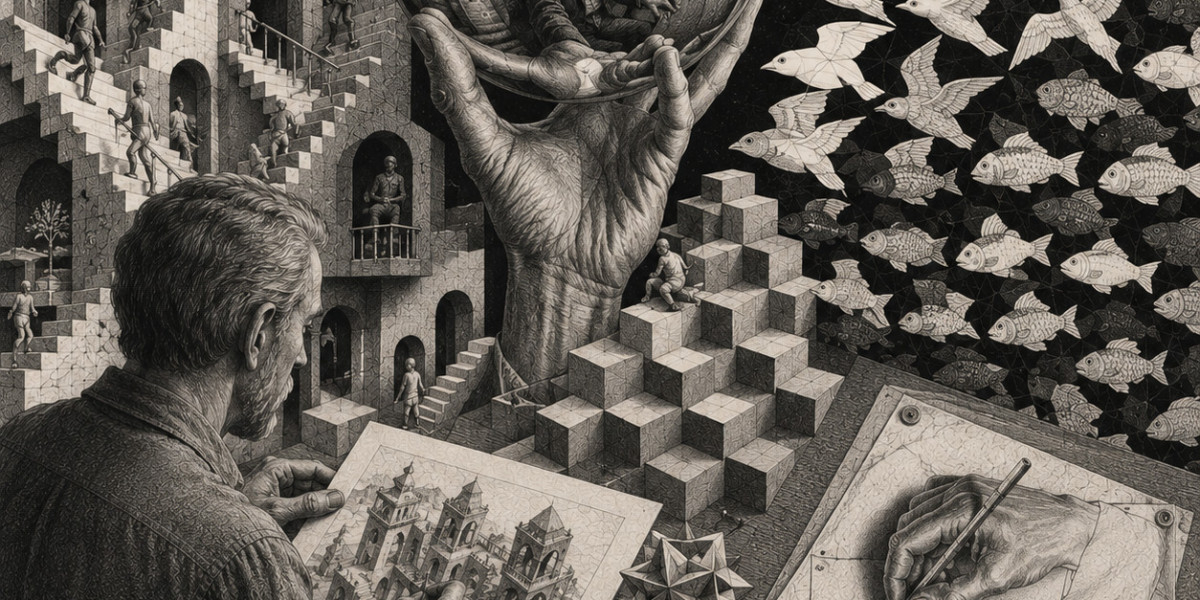

When exploring M.C. Escher's most famous art, it becomes clear that his appeal comes from much more than unusual visual effects. His works demonstrate exceptional technical discipline while exploring ideas about infinity, transformation, reflection, balance, and the structure of the natural world.
What Makes Escher’s Art So Recognizable?
Escher developed an artistic approach based on precision and experimentation. His compositions often feature repeated forms, impossible architectural structures, reflections, and figures that gradually transform into other shapes.
A major characteristic of his work is the way he combines order with imagination. Geometric structures provide a carefully organized foundation, while animals, landscapes, and fantastical forms introduce movement and visual storytelling.
This balance helps explain why M.C. Escher's most famous art continues to attract audiences with different interests. Art enthusiasts can appreciate his craftsmanship, while those interested in mathematics or geometry may be fascinated by the concepts underlying his compositions.
Escher’s Fascination With the Night Sky
The natural world inspired Escher throughout his artistic career, and the sky offered another opportunity to explore structure and perception. Stars and celestial forms appear in some of his compositions, contributing to his broader interest in worlds that seem to exist beyond ordinary experience.
The subject of M.C. Escher stars is particularly interesting because stars can be interpreted both as natural objects and as geometric symbols. Their shapes provide opportunities to explore symmetry, repetition, and transformation; ideas that were central to Escher’s artistic thinking.
Rather than simply depicting the night sky realistically, Escher was interested in how visual elements could be organized and transformed. A star could become part of a pattern, interact with surrounding forms, or contribute to a larger exploration of space.
From Nature to Geometry
Escher frequently looked to nature for forms that could be transformed through his artistic process. Animals, plants, landscapes, and celestial subjects could all become starting points for more abstract visual experiments.
His interest in stars fits naturally into this approach. A star has a recognizable shape, but it can also be reduced to geometric lines and repeating forms. This made it compatible with Escher’s fascination with symmetry and structured composition.
The resulting imagery demonstrates how he could move between realistic observation and abstract thinking. This ability is one of the reasons his work remains relevant to contemporary viewers.
The Importance of Symmetry
Symmetry is one of the fundamental principles found throughout Escher’s art. He explored different forms of symmetry to create balance while also introducing changes that kept his compositions visually dynamic.
In tessellations, for example, repeated figures can fit together with remarkable precision. Yet Escher often made these patterns more complex by gradually transforming one form into another.
Stars can also contribute to this visual language. Their geometric structure naturally lends itself to symmetrical arrangements, making them an interesting subject for an artist concerned with balance and repetition.
Studying M.C. Escher stars therefore offers another way to understand his broader interest in the relationship between mathematical order and artistic imagination.
Why Collectors Continue to Study Escher
Escher’s work offers collectors more than a visually striking image. Each composition can provide insight into the artist’s technical methods and intellectual interests.
Original prints can be particularly rewarding to examine because their intricate lines and carefully constructed details become more apparent when viewed closely. Collectors can discover how Escher used printmaking techniques to create complex visual relationships while maintaining exceptional clarity.
When considering M.C. Escher's most famous art, it can also be valuable to explore works beyond the images that initially made him widely recognized. His broader body of work reveals an artist who constantly experimented with perception, geometry, nature, and infinity.
Discovering Escher Through Walker Fine Art
For collectors and enthusiasts interested in exploring M.C. Escher’s work, Walker Fine Art offers a specialized collection devoted to the artist’s remarkable legacy. Viewing different works together can provide a greater understanding of the recurring ideas that shaped Escher’s career.
Whether your interest lies in impossible architecture, tessellation, reflections, transformations, or natural subjects such as stars, studying the artwork closely can reveal the depth of thought behind each composition.
A Legacy of Art, Mathematics, and Imagination
M.C. Escher demonstrated that art can exist at the intersection of creativity and intellectual exploration. His compositions encourage viewers to question what they see while appreciating the extraordinary craftsmanship behind every line.
The continuing fascination with M.C. Escher most famous art reflects the timeless quality of his ideas. His imagery remains engaging because it asks viewers to participate—to look closer, recognize patterns, and reconsider their understanding of space and form.
The exploration of M.C. Escher stars further demonstrates his ability to turn natural and geometric subjects into opportunities for artistic discovery. Through his remarkable body of work, Escher showed that mathematics does not have to limit imagination; instead, it can provide an entirely new language for creative expression.